
South Carolina isn’t Maine. It isn’t the Great Lakes. And the maintenance advice written for those climates doesn’t apply here.
Boating in South Carolina coastal waters — from the Grand Strand down through Charleston and into the Beaufort and Hilton Head Lowcountry — means dealing with conditions that most national maintenance guides barely mention. Water temperatures that stay above 70°F from May through November. Saltwater with an average salinity of 33.63 parts per thousand. Marine growth that doesn’t take a winter break the way it does up north. Pluff mud that sticks to everything and damages gel coat if you let it dry. A hurricane season that runs six months every year. And UV exposure intense enough to destroy unprotected vinyl and gel coat in a single summer.
This guide was written specifically for boat owners in South Carolina’s coastal waters. Every recommendation, every timeline, and every maintenance interval is calibrated to the conditions your boat actually lives in — not conditions in Connecticut or California.
Whether you just bought your first center console or you’ve been running the inshore creeks and offshore ledges for decades, this is the maintenance playbook for keeping a boat healthy, safe, and holding its value in SC’s beautiful but unforgiving saltwater environment.
The South Carolina Boating Calendar: What Your Boat Faces Each Month
Understanding what the water and weather are doing month by month is the foundation of smart maintenance in South Carolina. Here’s what your hull, engine, and systems are dealing with throughout the year.
January and February — the quietest months on the water, but not for your boat. Water temperatures bottom out around 58°F to 62°F in Charleston Harbor. Marine growth slows but doesn’t stop entirely — slime and soft fouling continue even in winter. This is the best time for haul-outs and major maintenance work because boatyard schedules are lightest. If you’re planning a bottom job, gelcoat repair, or hull coating application, book it now before the spring rush.
March and April — boating season begins. Water temperatures climb past 65°F and head toward 70°F. Barnacle larvae become active as water warms. This is when marine growth shifts from slow to aggressive. If your bottom paint is thin or your hull coating isn’t in good shape, you’ll start seeing fouling within weeks. Spring commissioning tasks — engine service, battery charging, safety gear checks, electronics testing — should be complete by mid-March. SC boating registration renewals are due every three years; check your expiration now.
May and June — peak boating arrives. Water temperatures push past 73°F and head toward 80°F. Marine growth is now in full assault mode. Barnacles, oyster spat, tube worms, and algae attach rapidly. Wet-slipped boats need hull cleaning every three to four weeks. UV intensity is approaching its annual peak — unprotected gel coat and vinyl begin oxidizing. Hurricane season officially starts June 1.
July and August — the hottest, most challenging months for your boat. Charleston Harbor water temperatures average 83°F to 84°F, making these the most aggressive fouling months of the year. Every week your hull sits in water without protection, more growth accumulates. Engine cooling systems work hardest — flush religiously after every saltwater outing. The heat accelerates fuel degradation; ethanol-blended fuel absorbs moisture faster in humidity. Afternoon thunderstorms are daily occurrences. Lightning is a real threat to electronics and rigging.
September and October — still warm, still growing. Water temperatures remain above 74°F through October. Marine growth continues at a strong pace. This is historically the peak of hurricane season in South Carolina — Hurricane Hugo hit Charleston on September 21, 1989. Hurricane Matthew struck in October 2016. Hurricane Ian impacted in September 2022. Your hurricane plan should have been finalized before June, but if you haven’t tested it, now is when it matters.
November and December — the season winds down. Water temperatures drop from the low 70s into the low 60s. Marine growth slows significantly as water cools below 65°F. This is an excellent time for a late-season haul-out, hull inspection, and winterization of systems you won’t use until spring. South Carolina winters are mild enough that most boats don’t need full winterization the way northern boats do — but engines, freshwater systems, and batteries still need attention.
After Every Saltwater Outing: The Non-Negotiable Routine
This is the single most important maintenance habit for any SC coastal boater. Do this after every single trip on saltwater, no exceptions. It takes 20 to 30 minutes and prevents 90 percent of avoidable corrosion damage.
Freshwater rinse the entire boat from top to bottom. Start at the hardtop or T-top and work down to the hull. Salt residue that looks invisible when wet becomes a corrosive coating when it dries. Pay extra attention to hardware, hinges, rod holders, grab rails, and any metal fastener exposed to spray.
Flush the engine immediately. Follow your engine manufacturer’s flush procedure — muff attachment or built-in flush port. Run fresh water through the cooling passages for a minimum of 5 to 10 minutes. In South Carolina’s saltwater, skipping a single flush can start the corrosion process inside cooling passages. This is not optional. It is the single cheapest thing you can do to prevent the single most expensive repair (overheated, corroded powerhead).
Rinse pluff mud off before it dries. If you’ve been running tidal creeks around Charleston, Beaufort, or the ACE Basin, your hull and lower unit are coated in Lowcountry pluff mud. This sulfur-rich marsh mud stains gel coat, corrodes metal, and hardens into a cement-like layer if left to dry. Rinse it off while it’s still wet. A hose-end nozzle handles it easily; dried pluff mud requires scrubbing that can damage gel coat.
Spray metal components with a corrosion inhibitor. Hit outboard powerheads, trim and tilt rams, stainless hardware, and electrical connections with a marine-grade corrosion inhibitor like CRC 6-56, Boeshield T-9, or Corrosion Block. This creates a protective film that displaces moisture and prevents salt from attacking metal surfaces between outings.
Rinse and treat vinyl upholstery. Salt and UV together destroy marine vinyl faster than either one alone. A quick freshwater rinse after each outing, combined with monthly UV protectant application, extends vinyl life by years.
Monthly Maintenance Tasks for SC Coastal Boats
Beyond the post-outing routine, these tasks should be performed every month during the active boating season (March through November in South Carolina).
Hull inspection (wet-slipped boats). If your boat stays in the water, check the waterline and below-waterline surfaces monthly. In Charleston’s warm water, a month of inattention during summer can produce heavy barnacle growth on an unprotected hull. If you’re using traditional bottom paint, verify it’s still active — faded, chalky paint has lost its biocide and is no longer protecting. If you’ve invested in a long-term hull coating like Aquaphobix, monthly inspections are still smart but you’re looking at light surface growth rather than hard fouling, and a diver with a soft pad handles it quickly.
Battery voltage check. Marine batteries discharge faster in heat. A battery that reads 12.4V is only 75 percent charged. Below 12.2V, you risk sulfation damage that shortens battery life permanently. If your boat sits for more than two weeks between outings, connect a maintenance charger. Check terminal connections for the white powdery corrosion that develops rapidly in salt air — clean with baking soda and water, then coat terminals with dielectric grease.
Bilge inspection. Check the bilge for water accumulation. A dry bilge is normal. Standing water means something is leaking — through-hull fitting, stuffing box, live well drain, or rain intrusion through deck hardware. Identify the source before it becomes a dockside sinking. SC marina managers will tell you that bilge pump failure combined with undetected leaks is the number one cause of boats sinking at the dock.
Fuel system check. South Carolina’s heat and humidity accelerate fuel degradation, especially in ethanol-blended fuel (E10 is standard at most SC fuel docks). Ethanol absorbs water from humid air through a process called phase separation — the ethanol bonds with water and drops to the bottom of the tank as a corrosive, engine-damaging sludge. If your boat sits for more than three weeks with fuel in the tank, use a fuel stabilizer. Check fuel water separators monthly and replace filter elements when discolored.
Anode inspection. Sacrificial anodes (zinc or aluminum) protect your engine’s lower unit, trim tabs, and through-hulls from galvanic corrosion. In South Carolina’s saltwater, anodes deplete faster than in freshwater. Check them monthly. When they’re 50 percent depleted, replace them. If anodes are disappearing in less than three months, you have a stray current or bonding issue that needs professional diagnosis immediately.
Gel coat and topside condition. UV degradation in SC is relentless. Check the gel coat for chalking, fading, or oxidation — early signs are a hazy appearance and rough texture. If you catch oxidation early, a machine polish and wax restores the finish. If you let it go, the gel coat breaks down to the point where professional wet sanding or respray is needed. Wax or ceramic sealant application every three to four months is the minimum for boats in SC sun exposure.
Seasonal Maintenance: The Four Big Services
Spring Commissioning (February to March)
This is your annual deep inspection — the equivalent of a car’s annual service. Complete before your first outing of the season.
Engine service: change oil and filter, replace fuel filter element, inspect and replace spark plugs per manufacturer schedule, inspect belts and hoses for cracking or swelling, check coolant levels (closed cooling systems), grease all fittings, inspect propeller for nicks and distortion, check lower unit oil for milky discoloration (indicates water intrusion — this is urgent if present). Most SC marine service centers recommend a full service every 100 engine hours or annually, whichever comes first. In heavy saltwater use, 75-hour intervals are smarter.
Electrical system: load-test all batteries, inspect wiring for frayed insulation or corroded connections, test navigation lights, verify VHF radio operation and DSC registration, test bilge pump and float switch manually.
Safety equipment: inspect PFDs for tears, mildew, or broken buckles. SC law requires children under 12 to wear a USCG-approved PFD at all times on boats under 16 feet. Verify fire extinguisher charge levels and expiration dates. Check flare expiration. Test horn. Inspect throwable Type IV device.
Trailer (if applicable): check tire pressure and tread, inspect wheel bearings (repack with marine grease annually), test brake lights and turn signals, inspect winch strap and bow hook, check coupler and safety chains. SC requires trailer registration for all trailers.
Hull: inspect bottom paint condition or hull coating integrity, check for blisters, cracks, or stress marks in gel coat, clean and wax topsides.
Mid-Season Check (July)
A shortened inspection during peak boating season to catch problems before they compound in the heat.
Re-check anode condition — SC summer heat and heavy use accelerate depletion. Inspect the fuel system for phase separation. Clean or replace engine air filters. Check live well pumps and washdown pumps. Inspect raw water strainer. Re-apply vinyl protectant. Touch up any gel coat chips before they absorb salt water and expand.
Hurricane Preparation (June Through November — Have a Plan Ready Before June 1)
South Carolina has roughly 500,000 state-registered recreational vessels. Around 40,000 are in Charleston County alone. When a hurricane threatens, every one of those boat owners needs a plan — and the boatyards, dry stacks, and trailer storage facilities fill up fast.
Your hurricane plan should answer three questions before the season starts. First, where will the boat go? Options are trailering to high ground (the safest), dry stack storage (check your facility’s hurricane rating and policy), in-water marina storage (double lines, position high on pilings, use fenders), or anchoring in a protected creek (the Wando River and upper Cooper River are common Charleston choices). Second, who executes the plan if you’re not available? Name a backup person with access to keys, codes, and your written plan. Third, what does your insurance actually cover? Read the policy now, not after the storm. Many policies require you to follow specific preparation steps or they deny claims.
When a storm enters the forecast, remove all canvas, electronics, cushions, and loose gear. Seal all openings — vents, exhaust ports, hatches. Close seacocks. Disconnect batteries. Fully charge batteries if staying in-water (bilge pump needs power). Snap timestamped photos of the boat’s condition before the storm for insurance documentation.
Fall / End of Season Service (November to December)
South Carolina’s mild winters mean most boats don’t need the aggressive winterization that northern boats require. However, several systems still need attention.
Stabilize fuel. Add fuel stabilizer to a full tank and run the engine long enough to circulate treated fuel through the entire system. A full tank prevents condensation from forming inside the tank over winter.
Fog the engine (if storing for more than 60 days). Fogging oil coats internal engine surfaces to prevent corrosion during periods of inactivity. Follow your engine manufacturer’s procedure.
Freshwater system: drain live wells, washdown tanks, and any freshwater plumbing. While hard freezes are rare in coastal SC, they do happen — a single night below 32°F can crack a plastic fitting in an exposed freshwater line.
Battery maintenance: fully charge all batteries and connect to a maintenance charger for the duration of storage. Disconnect battery terminals if no charger is available.
Cover the boat with a breathable cover or shrink wrap. Avoid airtight covers — they trap moisture and create mold and mildew problems. SC’s winter humidity is still high enough to cause mildew growth inside sealed spaces.
Hull Protection: The Most Expensive Maintenance Decision You’ll Make
In South Carolina’s warm saltwater, hull protection isn’t optional — it’s the single largest ongoing maintenance expense for any boat that stays in the water. The approach you choose determines whether you spend $3,000 to $8,000 every year or invest once and move on.
Traditional bottom paint is what most SC boat owners know. It works by leaching copper biocides into the water to kill marine growth. In Charleston’s heavy-fouling conditions, ablative bottom paint typically lasts 12 to 18 months before it needs to be sanded and reapplied. The annual cost for a 30-foot boat — including haul-out, sanding, paint, labor, and incidentals — runs $3,000 to $5,000 in the Charleston market. Over five years, that’s $15,000 to $25,000.
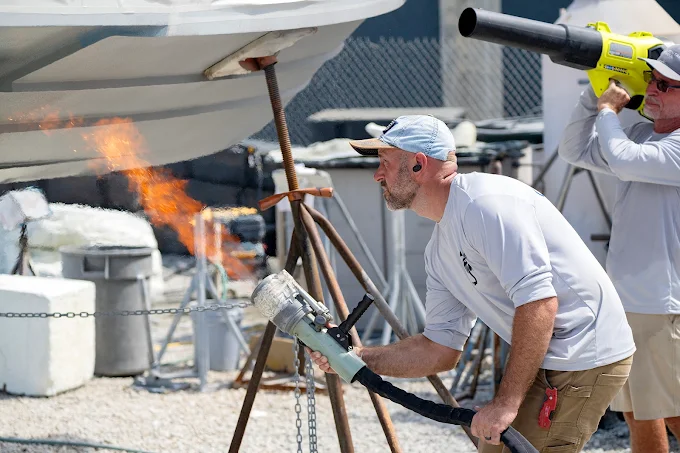
Thermoplastic hull coatings represent a fundamentally different approach. Aquaphobix, a torch-fused thermoplastic coating, is applied once and lasts 5 to 10 years. It bonds to the hull at over 850 PSI (more than double the adhesion of paint), contains zero copper or biocides, and is certified Marine Life Safe and Drinking Water Safe. Growth that attaches to the surface is weakly bonded and removes easily with a pressure washer or soft scrub. No sanding, no toxic dust, no annual reapplication. For SC boat owners tired of the bottom paint cycle, it’s the most significant maintenance decision they can make.
If you’re interested in learning more about hull coating alternatives, read our complete guide to bottom paint alternatives for boats in South Carolina.
Corrosion: South Carolina’s Silent Boat Killer
Corrosion destroys more value in South Carolina boats than any other single factor. Salt, heat, humidity, and stray electrical current all conspire to attack every metal surface on your vessel.
Galvanic corrosion happens when dissimilar metals are connected in saltwater — the less noble metal (aluminum, zinc) sacrifices itself to protect the more noble metal (stainless steel, bronze). This is why sacrificial anodes exist. Your engine’s lower unit, trim tabs, prop shaft, and through-hulls all depend on anodes to absorb corrosion instead of the critical components. In SC saltwater, check anodes monthly and replace at 50 percent depletion.
Stray current corrosion is far more destructive and harder to detect. A wiring fault — anywhere on your boat or even on a neighboring boat at the dock — can create electrical current flowing through the water and into your hull fittings. Stray current corrosion can eat through a bronze through-hull in weeks. Warning signs include anodes that disappear in less than 60 days, pitting on underwater metal surfaces, or unexplained discoloration around fittings. If you suspect stray current, get a marine electrician with a corrosion meter immediately. This is not a DIY diagnosis.
Crevice corrosion attacks stainless steel hardware — the type that covers most boats. Despite the name, stainless steel is not stain-proof. It requires oxygen to maintain its protective oxide layer. When salt water gets trapped in tight spaces — under a cleat, behind a hinge, inside a turnbuckle — the oxygen is consumed, and the stainless steel begins to corrode from the inside. In SC’s high-salinity environment, regular freshwater flushing and corrosion inhibitor treatment are the best defenses. Inspect all stainless hardware annually for rust bleeding, a telltale orange stain that signals active crevice corrosion beneath the surface.
Gel Coat and Fiberglass: Surviving SC’s UV Assault
South Carolina gets approximately 2,800 hours of sunshine per year. That UV exposure, combined with salt air and humidity, makes gel coat protection a critical maintenance priority.
Prevention is everything. Apply marine-grade wax or ceramic sealant every three to four months on boats in regular SC use. Ceramic coatings last longer than traditional wax — some products claim 12 to 24 months — but they require proper surface preparation and application technique. Whether you wax or ceramic coat, the goal is the same: maintain a sacrificial barrier between UV radiation and your gel coat.
If oxidation has started (chalky, hazy appearance), a machine compound and polish can usually restore the finish. This removes a microscopic layer of damaged gel coat and exposes fresh material underneath. Follow with wax or sealant immediately. If oxidation has progressed to the point where the gel coat is rough, thin, or exposing fiberglass weave, professional restoration or gelcoat respray is needed.
Pluff mud staining is unique to the Lowcountry. The iron-sulfide-rich marsh mud leaves yellow-brown stains on white gel coat that resist normal cleaning. Remove pluff mud stains with an oxalic acid–based hull cleaner — products like FSR (Fiberglass Stain Remover) or Mary Kate On & Off work well. Always rinse pluff mud off immediately after creek running; once it bakes in the sun, staining is much harder to reverse.
Engine Maintenance for SC Saltwater Conditions
The majority of SC coastal boaters run outboard engines, and the maintenance principles are straightforward but absolutely non-negotiable in saltwater.
Flushing is the single most important habit. Every outing. No exceptions. Five to ten minutes of fresh water through the cooling passages. Some engine manufacturers (Yamaha, Mercury, Suzuki) have built-in flush ports that make this easier. Use them. If your engine requires muff-style flushing, invest in a quality set and keep them at your rinse station.
Oil changes at manufacturer intervals — typically every 100 hours or annually for four-stroke outboards. In heavy SC use (100+ hours per season), consider 75-hour intervals. Use marine-grade oil, not automotive. Marine engines operate under higher loads and different thermal conditions.
Lower unit oil changes annually and after any impact event (running aground, hitting a submerged object). When you drain lower unit oil, inspect the color and consistency. Clear amber is normal. Milky or gray means water has entered through a damaged seal — this requires immediate professional attention before saltwater corrodes internal gears.
Water pump impeller replacement every 300 hours or every two to three years, whichever comes first. Impellers are rubber and degrade with heat and age. A failed impeller means no cooling water, which means engine overheat in minutes. This is a $200 preventive service that avoids a $5,000+ engine rebuild.
Fuel system maintenance matters more in SC because of ethanol and humidity. Use a fuel water separator (Racor-type) and check it monthly. Replace the filter element when discolored or at least annually. Add fuel stabilizer if the boat sits more than three weeks. Consider non-ethanol fuel where available — several SC marinas and fuel docks offer ethanol-free options at a premium.
Electrical Systems in Salt Air
SC’s salt-laden, humid air is hostile to electrical connections. Corrosion at wire terminals is the most common cause of intermittent electrical problems on boats in this region.
Inspect all connections annually. Look for green or white corrosion on copper terminals, heat discoloration on wire insulation, and loose crimps. Marine wiring should use tinned copper wire (not bare copper) and heat-shrink connectors with adhesive lining. If your boat was wired with bare copper and standard crimp connectors, plan to upgrade critical circuits over time.
Coat all exposed connections with dielectric grease or a corrosion inhibitor spray. This creates a moisture barrier that prevents salt air from attacking the metal.
Test your bilge pump system monthly. Fill the bilge with enough water to trigger the float switch and verify the pump activates. A bilge pump that doesn’t work when you need it can result in losing the boat at the dock.
VHF radio should be tested for transmit power annually. A corroded antenna connector can reduce your signal to a fraction of its rated range. In an emergency offshore, that lost range could mean the difference between being heard and not.
Trailer Maintenance for SC Coastal Boaters
If you trailer your boat, the trailer is exposed to the same saltwater, ramp conditions, and heat that attack the boat itself. SC boat ramps — especially tidal ramps — can be steep, slippery, and rough on equipment.
Wheel bearings are the most failure-prone component. Saltwater intrusion destroys bearings rapidly. Repack with marine-grade grease annually, or upgrade to bearing buddy–style grease-pressurized hubs that continuously seal out water. If you hear grinding or feel heat from a wheel hub after towing, stop immediately — a seized bearing can cause wheel separation at highway speed.
Brake systems (if equipped) corrode aggressively in saltwater. Flush drum brakes with fresh water after every ramp launch. Disc brakes are more salt-tolerant but still need inspection. SC requires functioning trailer brakes on trailers over 3,000 pounds gross vehicle weight.
Rinse the trailer with fresh water after every ramp launch. Pay attention to frame joints, spring hangers, and axle u-bolts — these are where rust starts. Keep the coupler and safety chain hardware clean and lubricated.
SC Boating Regulations That Affect Maintenance
Several South Carolina–specific regulations directly impact your maintenance obligations.
SC boat registration is handled by SCDNR (South Carolina Department of Natural Resources). Registration is valid for three years. The registration number must be displayed on both sides of the bow in at least three-inch letters. Your registration certificate must be on board whenever the vessel is in use.
SC requires USCG-approved PFDs for every person on board. Children under 12 must wear a PFD at all times on vessels under 16 feet. Fire extinguishers are required on boats with enclosed fuel compartments, enclosed living spaces, or permanent fuel tanks. These items should be inspected during your spring commissioning and replaced before they expire.
South Carolina prohibits the discharge of untreated sewage in state waters. If your vessel has a marine head, it must have a properly functioning holding tank or Type I/II marine sanitation device. Pump-out stations are available at most SC marinas — SCDNR maintains a statewide directory.
Frequently Asked Questions
How often should I wax my boat in South Carolina?
In South Carolina’s intense UV environment, wax your boat every three to four months if it’s used regularly and stored outdoors. If the boat is kept under a cover or in a dry stack, twice per year (spring and fall) is sufficient. Ceramic sealant products last longer but require proper application.
Do I need bottom paint if my boat is on a lift in South Carolina?
Not necessarily, but your hull will still accumulate growth during time in the water. In Charleston’s summer water temperatures (80°F+), marine organisms begin attaching within three to five days of water contact. If your boat goes in and out quickly, a fouling-release coating or regular rinse-down may suffice. For boats that spend extended periods in the water even intermittently, a long-term hull coating like Aquaphobix provides protection without the maintenance cycle of traditional paint.
Are aluminum or zinc anodes better for South Carolina saltwater?
Both work. Aluminum anodes perform well across salt, brackish, and fresh water, making them versatile for SC boaters who run everything from offshore saltwater to the brackish upper reaches of the Cooper or Edisto rivers. Zinc anodes are proven in pure saltwater environments. The important rule: never mix anode types on the same vessel. Pick one metal and use it consistently.
How do I prevent mold and mildew on my boat in South Carolina?
SC’s humidity makes mildew almost inevitable without active prevention. Maximize airflow — leave hatches cracked when the boat is covered (use bug screens), use moisture-absorbing products like DampRid in enclosed spaces, and clean any mildew immediately with a marine-grade mildew remover. Vinyl surfaces should be treated with a UV protectant that includes mildew inhibitors. Never seal a boat completely airtight in SC humidity.
What should I do if I run aground in a South Carolina tidal creek?
Running aground in the Lowcountry’s tidal creeks and oyster beds is extremely common — even experienced captains do it. Immediately tilt your engine up to protect the lower unit and propeller. If possible, shift weight to reduce draft. Wait for the tide if you’re firmly stuck. Once free, inspect the propeller for damage (nicks, bent blades), check the lower unit for oil leaks (indicating a damaged seal from impact), and inspect the hull for gouges or gel coat damage. If you hit oyster beds, check the hull carefully — oyster shell edges can cause deep scratches that need repair before saltwater intrudes into the fiberglass laminate.
How much does annual boat maintenance cost in the Charleston, SC area?
Annual maintenance costs in the Charleston market vary significantly by vessel size and how the boat is stored. As a rough baseline for a 25 to 30 foot center console: annual engine service runs $400 to $800, bottom paint (if wet-slipped) runs $2,000 to $5,000 including haul-out, detailing runs $500 to $1,500, and misc repairs and consumables add another $500 to $1,500. Total annual cost for a wet-slipped boat with traditional bottom paint: approximately $3,500 to $9,000. Trailered boats or boats on lifts with no bottom paint can reduce this significantly. Investing in a long-term hull coating eliminates the largest single recurring expense.
Get Expert Hull Protection for Your SC Boat
If you’re ready to eliminate the most expensive part of your annual boat maintenance — the bottom paint cycle — Aquatic Coatings is here to help.
We are a certified Aquaphobix applicator based in Charleston, SC. We apply the only torch-fused, non-toxic, thermoplastic hull coating on the market. One application protects your hull for 5 to 10 years, comes with a 5-year warranty, and contains zero copper or biocides.
Call 843-860-3989 for a free consultation, or request a quote online.
We serve boat owners across the South Carolina Lowcountry — Charleston, Mt. Pleasant, Daniel Island, Isle of Palms, Beaufort, Hilton Head, and everywhere in between.