If you keep a boat in South Carolina’s coastal waters, your hull is under constant attack. Barnacles, algae, tube worms, and oyster spat don’t sleep — and in water that stays above 70°F for seven months of the year, they don’t slow down either.
Boat hull coating in South Carolina isn’t a luxury. It’s the difference between a hull that performs, holds its value, and stays out of the boatyard — and one that drags, burns fuel, and costs you thousands in annual maintenance.
This guide covers everything SC boat owners need to know about hull coating options: what’s available, what actually works in warm southeastern saltwater, how much it costs, and how to choose the right solution for your vessel. Whether you’re docked in Charleston Harbor, slipped in a Hilton Head marina, or trailering out of Myrtle Beach, the information here applies directly to the conditions your boat faces every time it touches water.
Why Hull Coating Matters More in South Carolina Than Most Places
South Carolina’s coastal waters create a uniquely challenging environment for boat hulls. Understanding these conditions is essential to choosing the right protection.
Water temperature drives everything. Charleston Harbor averages 83°F in August, 74°F in October, and doesn’t drop below 59°F even in February. Marine fouling organisms — barnacles, algae, tube worms — reproduce and attach faster in warm water. A boat sitting in Charleston’s summer waters can develop visible barnacle growth in less than a week. Compare that to Maine or the Pacific Northwest, where colder temperatures give boat owners months of relative reprieve. South Carolina offers no such break.
Salinity is consistently high. The Atlantic coast off South Carolina maintains an average salinity around 33.6 parts per thousand — close to full ocean strength. This creates ideal conditions for hard-fouling organisms like barnacles and oyster spat, which thrive in high-salinity warm water. The brackish zones in tidal rivers and estuaries (the Cooper, Ashley, Wando, Edisto, Beaufort River) present their own challenges — different organisms, different growth rates, but equally relentless.
UV exposure accelerates surface degradation. South Carolina receives roughly 2,800 hours of sunshine annually. UV radiation breaks down unprotected gel coat, oxidizes paint, and degrades the biocide effectiveness of traditional antifouling coatings faster than in northern latitudes. A bottom paint that might last 18 months in the Chesapeake can give out in 10 to 12 months in Charleston.
The result: Boats in South Carolina coastal waters face more aggressive fouling, faster coating degradation, and higher long-term maintenance costs than boats in most other regions of the East Coast. The hull coating system you choose has to be calibrated for these conditions — not for the conditions printed on a national manufacturer’s spec sheet.
Understanding the Different Types of Boat Hull Coating
The term “hull coating” gets applied to several different products that work in fundamentally different ways. Here’s what each one actually does — and what it doesn’t.
Ablative Antifouling Paint
The traditional approach. Copper-based or copper-free paint is rolled or sprayed onto the hull. It works by slowly dissolving (ablating), releasing biocides that poison marine organisms before they can attach. When the paint wears away, you haul out and reapply.
Ablative paint has been the industry standard for decades, but it carries significant limitations in SC waters. The warm water accelerates biocide depletion. The paint erodes faster with frequent use. Every application requires sanding the previous layer, generating toxic dust. And the copper leaching into SC’s estuaries and marshlands is increasingly under regulatory scrutiny — California and Washington have already enacted restrictions on copper-based antifouling paints.
Lifespan in SC waters: 10 to 18 months typical. Reapplication: Annual or biannual.
Hard Bottom Paint
A non-ablative paint that doesn’t dissolve. Biocides leach out through the paint film while it remains intact on the hull. The paint surface can be scrubbed and burnished for a smooth racing finish. However, once the biocide is exhausted, you’re left with an inert shell that needs to be sanded down before recoating — and layers build up over time, eventually requiring expensive full stripping.
Lifespan in SC waters: 12 to 24 months before biocide exhaustion. Reapplication: Annual, with periodic full stripping required.
Fouling-Release Coatings (Silicone / Hydrophobic)
Slick, non-toxic coatings that create a surface so smooth that organisms can’t easily bond. Growth that does attach is weakened and washes off when the boat moves through water. No biocides are involved.
The concept is sound, but performance in warm SC saltwater is inconsistent. These coatings rely on water movement to self-clean — a boat sitting still in a Charleston slip during July and August will still accumulate growth. They work better on frequently used vessels and trailered boats.
Lifespan: 1 to 3 years depending on product and usage. Maintenance: Regular hull cleaning required.
Ceramic Coating (Above-Waterline Only)
This is an important distinction that confuses many SC boat owners. Marine ceramic coatings — products like Ceramic Pro Marine, System X Marine, or similar — are designed for surfaces above the waterline. They protect gel coat and paint from UV damage, oxidation, salt spray, and staining. They are excellent products for topsides.
However, ceramic coatings are not designed to prevent marine fouling below the waterline. They do not replace antifouling paint or hull coating. If someone offers you “ceramic coating” as a bottom protection solution, they’re either confused about the product or being misleading. Ceramic above the waterline, hull coating below — these are two different systems for two different jobs.
Thermoplastic Hull Coatings (Aquaphobix)
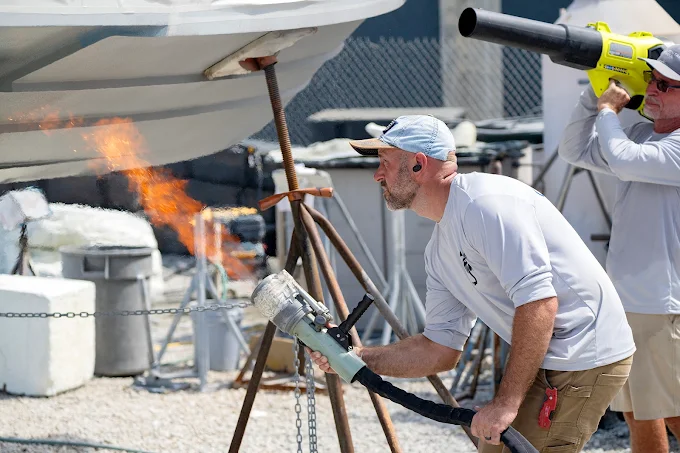
The newest category — and the most significant advancement in hull protection in decades. Aquaphobix is a thermoplastic coating that is heat-fused directly to the hull using a controlled propane torch. The powder melts on contact and forms a permanent molecular bond exceeding 850 PSI — more than double the adhesion of any paint.
The coating doesn’t erode, leach, peel, or dissolve. It contains zero biocides, zero copper, and zero heavy metals. It’s certified Marine Life Safe and Drinking Water Safe (NSF/ANSI 61). Marine growth that attaches to the surface bonds weakly and removes easily with a pressure washer or soft pad — without damaging the coating.
Lifespan: 5 to 10 years. Backed by a 5-year no-fine-print warranty. Maintenance: Periodic light cleaning only.
Thermoplastic Hull Coatings: The Breakthrough SC Boat Owners Should Know About
Aquaphobix represents a fundamentally different approach to hull protection. Rather than poisoning organisms (like paint) or trying to be too slippery for them (like silicone), it creates a physical barrier that is simply too hard, too smooth, and too well-bonded for organisms to get a permanent foothold.
The technology originated in the pool and aquatic facility industry. EcoFinish developed the thermoplastic application process for fiberglass swimming pools, where the coating had to withstand continuous water contact, chlorine, UV exposure, and daily use — while meeting municipal drinking water safety standards. Dan Dillon and his team in Islamorada, Florida adapted this proven technology for marine hulls, and Aquaphobix was born.
What makes it different from everything else on this list:
The 850+ PSI bond strength means the coating doesn’t separate from the hull under any normal operating conditions. Boats have been tested at speeds exceeding 60 mph with zero delamination. The coating doesn’t care whether your boat sits still or moves constantly — it doesn’t rely on water flow or biocide release to function. It provides the same protection whether your center console sits at a Shem Creek dock for three weeks in August or runs offshore to the Gulf Stream every weekend.
The environmental credentials are real and verifiable. Aquaphobix was approved for use in SeaWorld marine exhibits — facilities where continuous leachate monitoring is mandatory and any toxicity would disqualify the product immediately. It’s been applied to the historic Venetian Pool in Coral Gables, a municipally regulated facility filled with city aquifer water. These aren’t self-awarded marketing labels. They’re third-party certifications earned in regulated environments.
How Hull Coating Is Applied: The Aquaphobix Process
The application of Aquaphobix is unlike anything else in the marine coating industry. Here’s the step-by-step process that our certified technicians follow.
Surface preparation. The hull is sanded with 60-grit to create the optimal profile for adhesion. Any existing bottom paint is removed. Non-coated areas — waterline, through-hulls, transducers, running gear — are masked with fireproof tape.
Heat-activated epoxy primer. A specialized epoxy primer is rolled onto the prepared hull. This primer is formulated to activate under heat in the next step, creating the bonding bridge between the gelcoat substrate and the thermoplastic coating.
Torch-fused thermoplastic application. Thermoplastic powder is pneumatically sprayed onto the hull while simultaneously being melted by a controlled propane torch. The powder liquefies on contact with the primed surface, fusing into a solid, permanent layer. Three full coats are applied using this process.
Instant cure. Unlike traditional paints that need hours or days to dry (and can be ruined by humidity), Aquaphobix cures the instant it solidifies. There is no waiting period. Your boat can return to the water as soon as the final coat is applied.
The entire process typically takes one day for vessels under 30 feet. The application is not humidity-dependent, so it can be performed in conditions that would sideline a traditional paint crew.
Available colors: White, black, light gray, and light blue.
Boat Hull Coating vs. Bottom Paint: A Side-by-Side Comparison
This comparison uses real-world conditions for a 30-foot boat wet-slipped in South Carolina saltwater.
| Factor | Traditional Bottom Paint | Aquaphobix Thermoplastic Coating |
| How it works | Leaches biocides to poison organisms | Physical barrier — organisms can’t bond permanently |
| Contains copper/biocides | Yes | No — zero toxins |
| Bond strength | 200–400 PSI | 850+ PSI |
| Lifespan in SC waters | 10–18 months | 5–10 years |
| Reapplication frequency | Annual/biannual | None for 5+ years |
| Haul-outs required | Every application | One time |
| Sanding required | Every application | Initial prep only |
| Toxic dust generated | Yes — requires PPE | None |
| Environmental impact | Continuous copper leaching | Zero leaching, certified safe |
| Performance over time | Degrades as biocide depletes | Maintains protection |
| Warranty | None (industry standard) | 5-year, no fine print |
| Compatible with aluminum hulls | Copper paints: NO | Yes |
| Cure time | Hours to days | Instant |
| 5-year total cost (30-ft boat) | $15,000–$25,0 | Significantly lower |
The math alone makes the case. But for SC boat owners, the operational advantages are equally compelling — fewer haul-outs, zero toxic exposure, no scheduling fights with boatyards during spring rush, and a hull that actually gets smoother over time rather than degrading.
Boat Hull Coating vs. Ceramic Coating: Why They’re Not the Same Thing
This is the most common point of confusion we encounter with South Carolina boat owners, and it deserves clear explanation.
Several reputable companies in Charleston, Myrtle Beach, and Hilton Head offer marine ceramic coating — Palmetto Marine Restorations, ElitePro Detailing, Carolina Marine Restorations, and Double Down Detailing, among others. They do excellent work on topsides: gel coat protection, UV resistance, hydrophobic water shedding, and oxidation prevention.
But ceramic coating is specifically formulated for above-waterline surfaces. It does not prevent barnacles. It does not stop algae. It does not replace antifouling protection. If you apply ceramic coating below the waterline, marine organisms will attach to it just as readily as they would to unprotected gel coat.
The proper approach for complete vessel protection is to use both systems — ceramic coating above the waterline for UV and salt spray protection, and a dedicated hull coating like Aquaphobix below the waterline for marine growth prevention. These are complementary technologies, not competing ones.
The 5-Year Cost Analysis for SC Boat Owners
Every boat owner in South Carolina knows that bottom maintenance is expensive. Here’s what the numbers actually look like over a five-year ownership period for a 30-foot center console wet-slipped in Charleston.
Scenario A: Traditional bottom paint
Five years of annual haul-outs, sanding, painting, rack fees, dive cleaning, and zincs. Based on Charleston-area market rates: $3,000 to $5,000 per year. Five-year total: $15,000 to $25,000. At the end of five years, the hull needs the same treatment again. Asset value: zero.
Scenario B: Aquaphobix thermoplastic coating
One haul-out, one application, periodic light cleaning for five years. The coating is still performing at year five with years of remaining life. The 5-year warranty provides peace of mind throughout. Five-year total: substantially less than five years of traditional paint — with a protected hull that’s still working at the end.
The larger the vessel, the more dramatic the savings. A 40-foot yacht spending $6,000 to $10,000 annually on bottom paint saves tens of thousands over a five-year window.
Which Vessels Benefit Most from Professional Hull Coating
Aquaphobix hull coating works on fiberglass and aluminum hulls. The vessel types that see the greatest benefit in South Carolina include:
Center consoles and sportfishing boats. The backbone of SC coastal boating. These boats run hard, sit in slips, and their owners demand performance. A fouled hull means lost speed, higher fuel burn, and compromised fishing time. Hull coating eliminates that degradation.
Yachts and cruisers. The cost math is even more favorable at larger sizes. A 50-foot yacht paying $8,000 to $12,000 per bottom paint cycle sees enormous savings from a one-time coating application.
Charter and commercial vessels. Downtime is revenue loss. Every day in a boatyard is a day not earning income. Aquaphobix’s same-day cure and multi-year protection maximize operational uptime.
Sailboats. The ultra-smooth thermoplastic surface reduces hull drag in ways that ablative paints cannot match. Less drag means better performance under sail and improved fuel efficiency under power.
Aluminum boats. Aluminum hulls cannot use copper-based antifouling paint due to galvanic corrosion risk. Aquaphobix is 100% copper-free and bonds directly to aluminum — making it one of the very few effective hull protection options for aluminum vessel owners.
Service Areas: Hull Coating Across Coastal South Carolina
Aquatic Coatings is based in Charleston, South Carolina, and serves boat owners across the entire Lowcountry coast and beyond.
Charleston metro. Daniel Island, Mt. Pleasant, James Island, Johns Island, West Ashley, and all major boatyards including Cooper River Boatyard and Safe Harbor City Boatyard.
North of Charleston. Georgetown, Pawleys Island, and the Waccamaw River boating community.
Myrtle Beach and the Grand Strand. The Grand Strand’s massive recreational boating population has no local Aquaphobix applicator. We coordinate haul-out logistics with area boatyards to serve this market.
South of Charleston. Beaufort, Port Royal, Hilton Head Island, and Bluffton. The Sea Island boating community represents some of the most demanding vessel owners on the coast — and some of the most aggressive fouling conditions.
Isle of Palms, Sullivan’s Island, Kiawah, and Seabrook. Barrier island communities with high boat ownership and direct saltwater exposure.
No matter where your boat lives on the South Carolina coast, we can coordinate application at a boatyard near you.
Frequently Asked Questions
What is the best coating to put on a boat hull?
For boats in South Carolina’s warm saltwater, the best hull coating is one that doesn’t rely on biocide depletion and can withstand aggressive marine growth year-round. Thermoplastic coatings like Aquaphobix outperform traditional paints in these conditions because they provide a permanent physical barrier rather than a chemical one that erodes over time. The 850+ PSI bond strength and 5-year warranty provide durability that no bottom paint can match.
How much does boat hull coating cost in South Carolina?
Pricing depends on vessel size, hull condition, and whether existing bottom paint needs to be stripped. A professional thermoplastic hull coating application is more expensive upfront than a single bottom paint job — but significantly less expensive over a 5-year period when you account for the annual haul-outs, sanding, paint, labor, and cleaning that traditional bottom paint requires. For a personalized estimate, call 843-860-3989.
Is hull coating better than bottom paint?
In warm saltwater environments like South Carolina, thermoplastic hull coatings outperform traditional bottom paint on virtually every metric: longevity (5–10 years vs. 10–18 months), bond strength (850+ PSI vs. 200–400 PSI), environmental impact (zero toxins vs. continuous copper leaching), and total cost of ownership. The only advantage traditional bottom paint holds is lower upfront cost per application — but that advantage disappears entirely when calculated over multiple years.
How long does boat hull coating last?
Aquaphobix thermoplastic hull coating typically lasts 5 to 10 years. The coating comes with an industry-leading 5-year warranty with no fine print. Some industrial applications have documented 10 to 12 years of performance with only periodic pressure washing.
Can you ceramic coat a boat hull below the waterline?
Marine ceramic coating is designed for above-waterline surfaces only. It protects gel coat from UV damage, oxidation, and salt spray — but it does not prevent marine fouling below the waterline. For below-waterline protection, you need a dedicated hull coating system like Aquaphobix, antifouling paint, or a silicone fouling-release product.
What is the best anti-fouling coating for saltwater boats in South Carolina?
The most effective anti-fouling solution for SC saltwater depends on how you use your boat. For wet-slipped boats that sit in warm water for extended periods, thermoplastic coatings like Aquaphobix provide the most comprehensive and long-lasting protection. For trailered boats with limited water exposure, a fouling-release coating may be adequate. Traditional copper-based bottom paints remain functional but require annual reapplication and carry increasing environmental and regulatory risk.
Does hull coating work on aluminum boats?
Yes. Aquaphobix bonds to both fiberglass and aluminum substrates. This is a significant advantage for aluminum boat owners, who cannot use copper-based antifouling paints due to galvanic corrosion risk. Aquaphobix contains zero copper and zero metals, making it one of the only effective hull protection systems safe for aluminum hulls.
Is Aquaphobix really non-toxic?
The certifications are third-party verified, not self-awarded. Aquaphobix holds NSF/ANSI 61 certification (Drinking Water Safe) and Marine Life Safe certification. It has been approved for use in SeaWorld marine exhibits and municipal aquatic facilities where continuous leachate monitoring is mandatory. Zero biocides, zero copper, zero heavy metals, zero chemical leaching.
Get Professional Boat Hull Coating in South Carolina
You’ve researched the options. You understand the conditions your hull faces in SC waters. You’ve seen the cost comparison. Now it’s time to talk to the people who actually apply the coating — right here in the Lowcountry.
Aquatic Coatings is a certified Aquaphobix applicator based in Charleston, South Carolina. We provide the only torch-fused, non-toxic, thermoplastic hull coating service on the South Carolina coast.