Every boat owner in South Carolina eventually arrives at the same question: is there something better than bottom paint?
You already know the cycle. Haul out. Sand. Scrape toxic copper dust while wearing a respirator two feet from the water. Roll on two coats of paint that starts degrading the moment your hull touches the harbor. Pay $3,000 to $8,000. Repeat every 12 to 18 months.
In South Carolina’s warm saltwater — where surface temps stay above 70°F for six months and barnacle larvae don’t take a winter break — that cycle is more brutal and more expensive than almost anywhere else on the East Coast. Charleston, Beaufort, and Hilton Head boaters deal with some of the most aggressive marine fouling conditions in the country.
So yes, alternatives exist. Some of them work well. Some of them don’t. Some are genuine breakthroughs. Others are expensive disappointments wrapped in slick marketing.
This guide breaks down every real alternative to traditional antifouling bottom paint available to South Carolina boat owners in 2026. No product shilling. No vague claims. Just an honest assessment of what each option actually does, what it costs, how long it lasts, and how it performs in warm southeastern saltwater — the conditions your boat actually lives in.
Why Traditional Bottom Paint Is a Problem (Beyond the Hassle)
Before we get to the alternatives, it helps to understand what you’re actually replacing and why. Traditional bottom paint isn’t just inconvenient. It’s fundamentally flawed in three ways that matter to South Carolina boat owners.
It’s designed to self-destruct. Ablative antifouling paints work by slowly eroding. That’s the mechanism — the paint sheds layers of copper or biocide into the water, and as it dissolves, it takes fouling organisms with it. The paint is literally engineered to disappear. When it’s gone, you start over. In warm waters like the Charleston Harbor or Port Royal Sound, that erosion happens faster because marine organisms are more active and water conditions are more aggressive. A paint that lasts 18 months in Maine might give you 10 to 12 in South Carolina.
It poisons the water it sits in. The active ingredient in most antifouling paints is copper oxide. Copper is effective at killing barnacle larvae, but it doesn’t stop at barnacle larvae. It leaches into the water column continuously, accumulating in marina sediment, entering the food chain through filter feeders like oysters and mussels, and damaging the larval stages of fish and invertebrates. An EPA-funded study by the Port of San Diego found that copper concentrations in enclosed marinas with high boat density regularly exceeded safe thresholds for aquatic life. South Carolina’s estuaries, marshlands, and inshore fisheries are particularly vulnerable because they are shallow, warm, and tidal — exactly the conditions that concentrate copper pollution.
It gets more expensive every year, not less. Paint prices have risen steadily. Haul-out rates at Charleston boatyards have climbed. Environmental disposal fees are now standard. Dive cleaning between paint jobs runs $150 to $250 per visit in this market, and most wet-slipped boats in SC waters need cleaning every three to four weeks during the warm months. A boat owner who keeps a 30-footer in the water year-round in Charleston can easily spend $5,000 to $8,000 annually on bottom paint, cleaning, and haul-outs combined. Over five years, that’s $25,000 to $40,000 — and at the end, you have nothing to show for it except a hull that needs the same treatment all over again.
The alternatives below attempt to solve some or all of these problems. They vary widely in approach, effectiveness, and cost.
Alternative 1: Copper-Free Antifouling Paint
What it is: Traditional bottom paint reformulated without copper. Uses alternative biocides like Econea (a non-metallic synthetic compound) or zinc pyrithione to prevent fouling. Applied, maintained, and reapplied exactly like conventional bottom paint.
How it works: Same mechanism as copper paint — biocides leach out over time to discourage marine growth. The difference is that Econea biodegrades rapidly and doesn’t accumulate in sediment the way copper does. It’s safe for aluminum hulls (copper is not), and it doesn’t cause galvanic corrosion.
Products in this category: Pettit Hydrocoat Eco, Interlux Pacifica Plus, TotalBoat AlumiPaint AF.
The honest assessment for SC waters:
Copper-free paints are a step in the right direction environmentally, but they don’t solve the core problem. You still haul out every season. You still sand, prep, and reapply. You still pay for the cycle. Some boaters in the Southeast report that copper-free formulations are slightly less effective against hard fouling (barnacles, tube worms) compared to high-copper paints — which is a meaningful concern in South Carolina’s heavy-growth conditions. The slime-fighting performance also varies; Econea handles hard growth well but does nothing for algae without a secondary biocide like zinc pyrithione added to the formula.
Durability: 1 to 2 seasons (same as conventional paint). Cost: $180 to $300 per gallon. Total annual cost with labor is comparable to traditional bottom paint.
Environmental impact: Significantly lower than copper paints. Econea is biodegradable. SC warm saltwater performance: Moderate. Effective but not superior to copper in high-growth areas. Best for: Aluminum boat owners who can’t use copper. Eco-conscious boaters who want a direct swap without changing their maintenance routine.
Alternative 2: Hydrophobic Fouling-Release Coatings (Wipe-On)
What it is: A clear or translucent liquid coating that creates a slippery, non-stick surface on the hull. Marine organisms can’t get a strong grip, and water movement washes them off. Think of it like a wax or ceramic sealant for your hull bottom.
How it works: These coatings don’t kill anything. They create a surface with very low surface energy — so smooth and slick that organisms slide off when the boat moves through water. The hull needs to be moving regularly for this to work. On a stationary hull, growth will eventually attach.
Products in this category: Aurora Marine VS721 Bottom Coat, PropSpeed (for running gear), CeRam-Kote.
The honest assessment for SC waters:
This is where a lot of SC boat owners get disappointed. Fouling-release coatings can work reasonably well on trailered boats that go in and out of the water regularly — the hull is clean when it launches, picks up minimal growth during a day or weekend on the water, and gets rinsed when it comes back out. But for boats that sit in a wet slip or on a mooring in warm South Carolina saltwater? The results are often poor. Growth in this region is too aggressive. A boat sitting still in 80°F water will start growing slime within 3 to 5 days, and no slippery coating prevents that without regular movement.
VS721, for example, claims that “movement of boat through water continuously cleans hull.” That works great for a boat that moves daily. For a center console sitting in a Shem Creek marina slip from April through October, it’s a recipe for barnacles.
Durability: Needs reapplication every season. Some claim two seasons in lower-growth environments. Cost: $50 to $150 per application (DIY product). Very low cost relative to paint. Environmental impact: Excellent. No biocides, no heavy metals, no leaching. SC warm saltwater performance: Poor to fair for wet-slipped boats. Better for trailered boats with frequent use. Best for: Trailered boats, boats on lifts with short water exposure, running gear protection (props, trim tabs, struts).
Alternative 3: Silicone-Based Hull Coatings
What it is: A hard, non-ablative silicone coating (silane/siloxane formulation) that creates a permanent, ultra-smooth surface. Unlike fouling-release wipe-ons, these are professionally applied (or carefully DIY’d) and intended to last multiple years.
How it works: Similar principle to fouling-release coatings, but far more durable. The silicone creates a surface with extremely low friction and surface energy. Marine growth has difficulty bonding at the molecular level. Growth that does attach is weaker and easier to remove with light scrubbing.
Products in this category: Sea-Speed V 10 X Ultra, Hempel Silic One.
The honest assessment for SC waters:
Silicone coatings are a genuine step up from wipe-on fouling release. Sea-Speed claims a 10-year warranty and has real-world performance data on commercial vessels. Hempel Silic One won “best in test” in Practical Boat Owner’s antifouling head-to-head comparison. The technology works. However, there are caveats. These coatings still rely on the hull moving through water to self-clean effectively. A boat that sits idle for weeks in warm water will accumulate growth — it just comes off more easily during cleaning. The initial application cost is higher than paint, and surface preparation is critical. If the coating doesn’t adhere properly, it can fail in patches, which is worse than no coating at all.
Availability is also an issue. Sea-Speed is a small manufacturer. Finding a qualified applicator in South Carolina is difficult, and DIY application requires careful technique.
Durability: 5 to 10+ years (manufacturer claims). Real-world 3 to 7 years reported. Cost: Higher upfront ($2,000 to $5,000+ depending on vessel size). Low ongoing cost if it lasts as claimed. Environmental impact: Excellent. Non-toxic, non-ablative, no leaching. SC warm saltwater performance: Fair to good. Better than wipe-ons, but still needs regular use or periodic cleaning. Best for: Performance boats, sailboat racers, commercial vessels with frequent movement.
Alternative 4: Copper Epoxy Coatings (Coppercoat)
What it is: A two-part epoxy coating embedded with fine copper powder. Unlike ablative copper paint that sheds layers, Coppercoat locks copper particles permanently in an epoxy matrix. As the surface slowly wears, fresh copper is exposed — but the coating doesn’t dissolve or erode the way paint does.
How it works: Copper particles are suspended in a hard epoxy shell. The copper leaches at a much slower rate than ablative paint because it’s trapped in epoxy rather than designed to dissolve. The hull can be scrubbed aggressively without damaging the coating. Coppercoat claims a 10-year lifespan with periodic burnishing to expose fresh copper.
Products in this category: Coppercoat (the dominant brand). A few other copper-epoxy systems exist.
The honest assessment for SC waters:
Coppercoat has a loyal following, particularly among long-distance cruisers and liveaboards who want multi-year protection without frequent haul-outs. The performance data is solid — independent testing shows it holds up well over multiple seasons, and it can be scrubbed hard without coming off. It is meaningfully better than traditional ablative paint in terms of longevity.
But there are two problems for environmentally-conscious boat owners. First, it still contains copper. The leaching rate is lower than ablative paint, but it’s not zero. Coppercoat is not biocide-free and would likely be affected by the copper paint restrictions already enacted in California and Washington and under consideration in other states. Second, the initial application requires stripping the hull to bare substrate (gelcoat or fiberglass), which is an expensive and labor-intensive process — typically requiring media blasting. This means the upfront cost is often $5,000 to $10,000+ for a mid-size boat, though the annualized cost over 10 years can be competitive with traditional paint.
Durability: 10+ years with maintenance (burnishing every 2 to 3 years). Cost: $5,000 to $10,000+ initial application. Low ongoing cost. Environmental impact: Better than ablative paint (slower leaching) but still contains copper. Not future-proof against regulatory bans. SC warm saltwater performance: Good. Well-suited for high-growth areas. Can be scrubbed frequently. Best for: Liveaboards, cruisers, boat owners committed to long-term ownership who aren’t concerned about copper regulations.
Alternative 5: Ultrasonic Antifouling Systems
What it is: An electronic device mounted inside the hull that emits high-frequency ultrasonic pulses through the hull material. The vibrations are intended to create a microscopic environment at the hull surface that prevents organisms from settling.
How it works: Transducers are bonded to the inside of the hull with epoxy. A control unit pulses ultrasonic frequencies (typically 20 to 200 kHz) through the hull, creating micro-vibrations that disrupt the initial stages of biofilm formation. The theory is that if you prevent the conditioning film (the first stage of fouling), you prevent everything that follows.
Products in this category: Sonihull, Hasytec, CleanAHull, Hull Shield, NRG Marine.
The honest assessment for SC waters:
This is the alternative that generates the most debate — and the most disappointment. The technology sounds compelling on paper. In practice, independent testing and real-world user reports present a mixed picture at best.
Practical Sailor’s multi-month field test on a boat in Sarasota, Florida — warm saltwater conditions similar to South Carolina — concluded that the ultrasonic device they tested produced no significant improvement over the control boat. Multiple forum reports on Trawler Forum and The Hull Truth describe similar results: partial effectiveness near the transducers, little to no effect on the rest of the hull, and no ability to replace bottom paint.
Even manufacturers acknowledge that ultrasonic systems are designed to work alongside bottom paint, not replace it. They can potentially extend the life of existing paint and reduce hard growth (barnacles, tube worms) near the transducers. But they do not eliminate the need for antifouling protection, and they do not prevent slime, algae, or soft growth.
Additional concerns for SC boat owners: the systems require constant power (0.5 to 1 amp draw, 24/7), which means shore power or robust solar/battery systems. Effectiveness decreases on cored hulls and doesn’t work on wood or ferro-cement. There are also unresolved questions about the impact of continuous ultrasonic emissions on marine life — the same frequencies that deter barnacle larvae may also affect other organisms.
Durability: Electronic components last 5 to 10 years. Does not replace hull coating. Cost: $800 to $2,500 for the system. Still requires bottom paint or another coating underneath. Environmental impact: No chemicals. But the marine life impact of continuous ultrasonic emissions is poorly studied. SC warm saltwater performance: Poor as a standalone solution. May supplement paint in high-growth areas. Best for: Boat owners willing to add a supplemental layer of protection on top of existing antifouling — not a replacement.
Alternative 6: Hull Wraps and Anti-Fouling Films
What it is: A physical film or wrap applied to the hull surface, similar in concept to vinyl wrapping a car. The film creates a smooth, non-stick barrier that organisms can’t easily bond to, and it can be removed and replaced without sanding or chemical stripping.
How it works: Adhesive-backed films are applied to a clean, prepped hull. The film’s surface texture or chemistry (some incorporate micro-spines modeled after sea urchins) makes it difficult for organisms to attach. When the film wears out or gets damaged, it can be peeled off and replaced — no sanding, no toxic waste.
Products in this category: Finsulate (Netherlands-based), ePaint ZO hull film (limited availability), various marine vinyl wraps marketed for antifouling.
The honest assessment for SC waters:
Hull wraps are an emerging technology with limited real-world track record in the United States, and virtually no presence in the South Carolina market. Finsulate, the most prominent manufacturer, has received positive attention in European waters, but availability, installation expertise, and long-term performance data in warm southeastern US waters are essentially nonexistent.
The concept is promising: no toxins, removable, recyclable, and it physically prevents growth rather than chemically poisoning it. But the practical challenges are significant. Application requires a perfectly clean, smooth hull surface. Adhesion in warm water with significant thermal expansion is uncertain. Damage from dock strikes, groundings, or debris creates weak points. And there are no certified installers in South Carolina that we’re aware of.
Durability: Manufacturer claims 3 to 5 years. Limited independent data. Cost: Comparable to professional bottom paint application. Replacement costs unknown in the US market. Environmental impact: Excellent. No chemicals, recyclable. SC warm saltwater performance: Unknown. No significant track record in this region. Best for: Early adopters willing to experiment with emerging technology. Better suited for commercial vessels with controlled operating environments.
Alternative 7: Thermoplastic Hull Coatings (Aquaphobix)
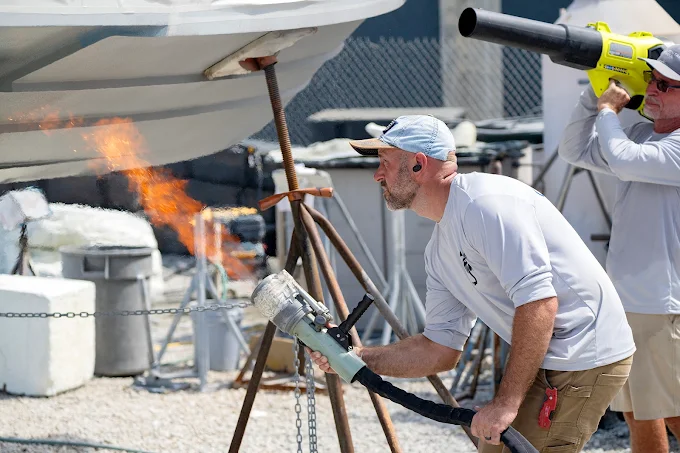
What it is: A permanent thermoplastic coating that is heat-fused directly to the hull using a controlled propane torch system. The thermoplastic powder is pneumatically sprayed onto the hull while being melted in place, creating a molecular bond that exceeds 850 PSI — more than double the adhesion of any conventional paint.
How it works: This is fundamentally different from every other option on this list. Aquaphobix is not a paint that sits on top of the gelcoat. It’s not a wipe-on coating that creates a temporary slick surface. It’s a thermoplastic material that fuses with the primed hull at a molecular level, becoming part of the hull surface itself. The coating doesn’t erode, leach, peel, chip, or dissolve. It creates an ultra-smooth, non-porous surface that marine organisms cannot easily bond to. Growth that does attach is weakly bonded and removes easily with a pressure washer or soft scrub — without damaging the coating and without releasing any chemicals into the water.
Aquaphobix was adapted from a pool surfacing technology that has been used on thousands of fiberglass swimming pools and commercial aquatic facilities — including SeaWorld exhibits and the historic Venetian Pool in Coral Gables, Florida, where the coating is in direct contact with municipal drinking water.
Products in this category: Aquaphobix is currently the only torch-applied thermoplastic marine hull coating with third-party certifications.
The honest assessment for SC waters:
Aquaphobix addresses the shortcomings that plague every other alternative on this list.
Unlike copper-free paints, it doesn’t need to be reapplied every season. Unlike fouling-release coatings, it doesn’t depend on the boat moving frequently to stay clean. Unlike silicone coatings, the 850+ PSI bond strength means it doesn’t delaminate in areas of high water flow or physical contact. Unlike Coppercoat, it contains zero copper and zero biocides, making it fully compliant with current and future environmental regulations. Unlike ultrasonic systems, it actually works as a standalone hull protection system. Unlike hull wraps, it has a multi-year track record on hundreds of vessels.
The application process requires trained, certified technicians — you can’t buy this at West Marine and roll it on yourself. That’s by design. The torch-on application is precise and technical, and proper execution is what delivers the bond strength and longevity the product is known for.
In South Carolina’s warm saltwater, Aquaphobix performs well because it doesn’t rely on biocide leaching (which accelerates in warm water and leaves you unprotected sooner) or boat movement (which is irrelevant to a hull sitting in a Beaufort slip in August). It provides a physical barrier that works regardless of water temperature, boat usage patterns, or how long the vessel sits idle.
The coating is certified Marine Life Safe and Drinking Water Safe (NSF/ANSI 61) — these aren’t self-awarded labels. They’re third-party verified standards that require continuous leachate monitoring and environmental testing.
Does Aquaphobix prevent ALL marine growth? No. No bottom protection system does — not copper paint, not silicone, not anything. What Aquaphobix does is make growth dramatically easier to manage. A diver with a soft pad handles it in minutes, and the coating remains completely intact afterward. You’re not scraping paint off along with the barnacles.
Durability: 5 to 10 years. Industry-leading 5-year no-fine-print warranty. Cost: Higher upfront than a single paint job. Significantly lower than five years of traditional bottom paint. Environmental impact: Best-in-class. Zero biocides, zero copper, zero heavy metals, zero leaching. Third-party certified. SC warm saltwater performance: Excellent. Designed for exactly these conditions. Best for: Boat owners who want to stop the annual bottom paint cycle entirely. Wet-slipped vessels in high-growth areas. Environmentally-conscious owners. Anyone who values long-term cost savings over low upfront cost.
The Full Comparison: Every Alternative Side by Side
| Factor | Copper-Free Paint | Fouling Release (VS721) | Silicone Coating | Coppercoat | Ultrasonic System | Hull Wraps | Aquaphobix |
| Lifespan | 1–2 seasons | 1 season | 3–7 years | 10+ years | N/A (supplement only) | 3–5 years (claimed) | 5–10 years |
| Reapplication needed | Annual | Annual | Rare | Burnish every 2–3 yrs | N/A | Replace film | None for 5+ yrs |
| Contains biocides | Yes (Econea) | No | No | Yes (copper) | No | No | No |
| Contains copper | No | No | No | Yes | No | No | No |
| Future-proof vs. bans | Partially | Yes | Yes | No | Yes | Yes | Yes |
| Works on stationary hulls | Yes | Poorly | Fair | Yes | Supplement only | Unknown | Yes |
| SC warm saltwater rating | Moderate | Poor (wet-slip) | Fair-Good | Good | Poor (standalone) | Unknown | Excellent |
| Bond strength | Low (200–400 PSI) | Minimal | Moderate | High | N/A | Adhesive | 850+ PSI |
| DIY possible | Yes | Yes | Difficult | No | Yes | No | No |
| 5-year total cost (30 ft) | $15,000–$25,000 | $500–$1,000 + paint costs | $3,000–$6,000 | $5,000–$10,000 | $1,000–$2,500 + paint | Unknown | Significantly less than paint |
| Warranty | None | None | Varies | 10 yr (manufacturer) | 1–2 yr (electronics) | Varies | 5 yr, no fine print |
| Certified safe for marine life | No (biocide-based) | Not certified | Not certified | No (copper-based) | Not applicable | Not certified | Yes (NSF/ANSI 61) |
What South Carolina Boat Owners Should Actually Do
If you’ve read this far, you’re not looking for someone to tell you which brand of ablative paint to buy. You’re looking for a way out of the cycle entirely.
Here’s our recommendation based on how you use your boat:
If you trailer your boat and it’s only in saltwater for hours or days at a time — you may not need bottom protection at all. A fouling-release wipe-on like VS721 can help keep the hull clean between uses. Rinse after every outing.
If you keep your boat on a lift and it’s in the water for a few days at a time — a fouling-release coating may be adequate, supplemented by freshwater rinsing when the boat comes out. If growth is still a problem, consider Aquaphobix as a one-time solution that eliminates the worry entirely.
If your boat is wet-slipped year-round in South Carolina saltwater — this is where the alternatives truly diverge. Copper-free paint keeps you in the same annual cycle. Silicone coatings and ultrasonic systems will disappoint you in these conditions. Coppercoat is durable but still contains copper and faces regulatory risk. Aquaphobix is the only option that genuinely ends the cycle: one application, multi-year protection, zero toxins, and a hull that performs better with age rather than degrading.
Frequently Asked Questions
What can I use instead of bottom paint on my boat?
There are seven main categories of alternatives: copper-free antifouling paints, hydrophobic fouling-release coatings, silicone-based hull coatings, copper-epoxy systems like Coppercoat, ultrasonic antifouling devices, hull wraps, and thermoplastic coatings like Aquaphobix. Each works differently and suits different boat usage patterns. For boats in warm South Carolina saltwater that sit in wet slips, thermoplastic coatings offer the most complete replacement for traditional bottom paint.
Is there a permanent alternative to antifouling paint?
The closest to permanent is a thermoplastic coating like Aquaphobix, which lasts 5 to 10 years with no reapplication and bonds to the hull at over 850 PSI. Coppercoat can also last 10+ years but still contains copper. No coating lasts forever, but these multi-year systems eliminate the annual repainting cycle that traditional paints require.
What is the best eco-friendly bottom coating for boats?
Aquaphobix is the only marine hull coating certified as both Marine Life Safe and Drinking Water Safe (NSF/ANSI 61). It contains zero biocides, zero copper, and zero heavy metals, and it has been verified in environments like SeaWorld exhibits and municipal pools. Among available alternatives, it has the strongest third-party environmental credentials.
Do ultrasonic antifouling systems work?
The evidence is mixed. Independent testing by Practical Sailor showed no significant improvement on a test boat in warm Florida waters. Forum reports from boat owners range from partial success (reduced hard growth near transducers) to complete failure. Even manufacturers position ultrasonic systems as supplements to bottom paint, not replacements for it. For South Carolina waters, ultrasonic alone is not sufficient for a wet-slipped boat.
Can I use ceramic coating instead of bottom paint?
Marine ceramic coatings (like Ceramic Pro Marine) are designed for above-waterline surfaces — hull topsides, gelcoat, upholstery, metal trim. They protect against UV damage, oxidation, and surface contamination. They are not designed for below-waterline antifouling and will not prevent barnacles, algae, or marine growth. A ceramic coating and a hull coating like Aquaphobix serve completely different purposes. Some boat owners use both — ceramic above the waterline, Aquaphobix below.
Get an Alternative to Bottom Paint Applied in South Carolina
Aquatic Coatings is a certified Aquaphobix applicator based in Charleston, SC. We apply the only torch-fused, non-toxic thermoplastic hull coating on the market — right here in the Lowcountry, for boat owners who are ready to stop the bottom paint cycle for good.
Whether you own a 22-foot bay boat or a 50-foot sportfisher, we can walk you through the process, the cost, and the timeline for your specific vessel.
Call 843-860-3989 for a free consultation — or fill out our contact form and we’ll get back to you within 24 hours.
We serve Charleston, Mt. Pleasant, Daniel Island, James Island, Beaufort, Hilton Head, and the entire South Carolina coast.